Upright, spinet and console piano movers
Vertical pianos weigh more than they look and carry that weight high. Here's how they're moved up and down stairs, and what to check before moving day.
- Stairs and basements
- Free in-home estimates
- ILCC 73744 MC-C licensed
- One customer per truck
How heavy is an upright piano, and how do movers get one down stairs?
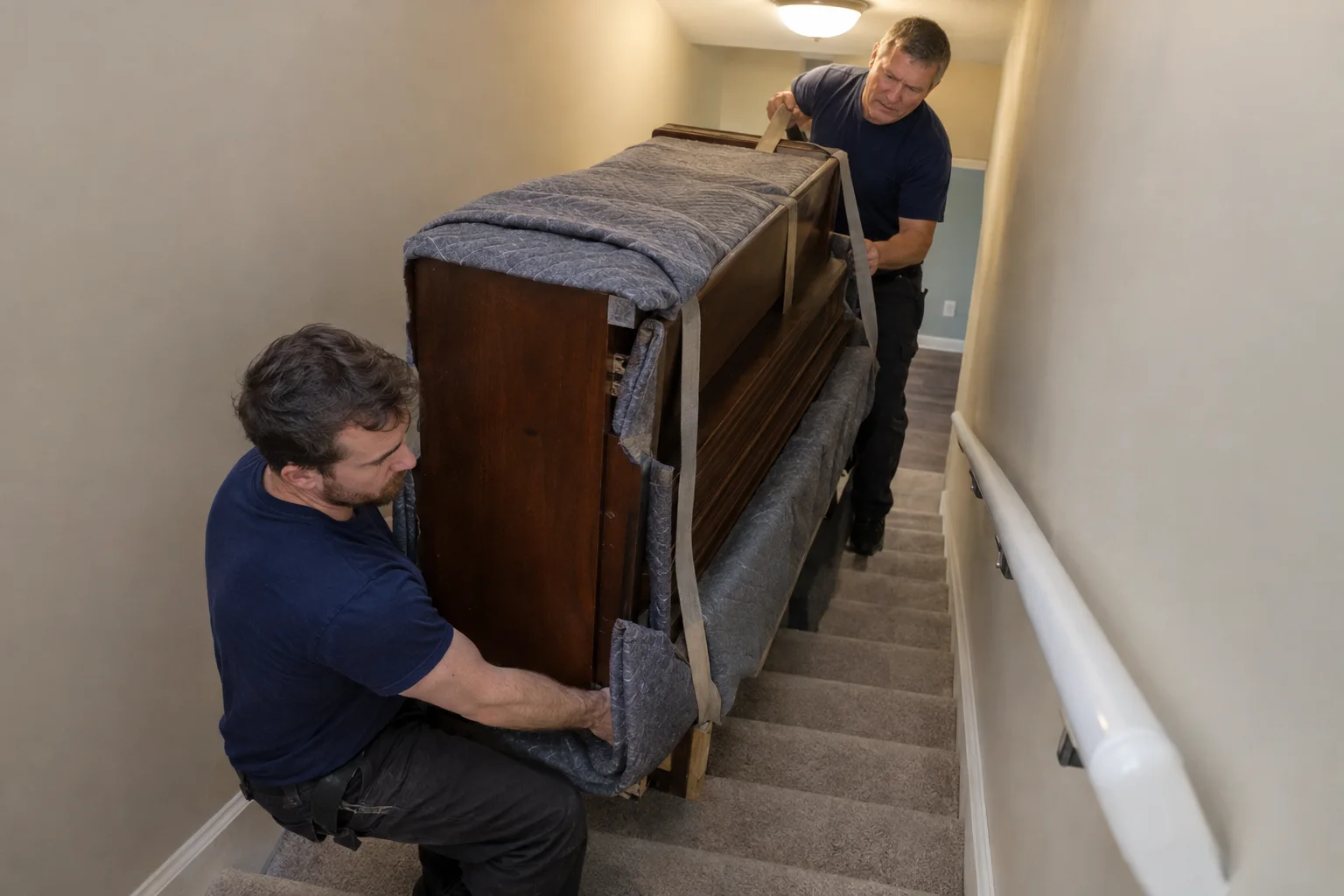
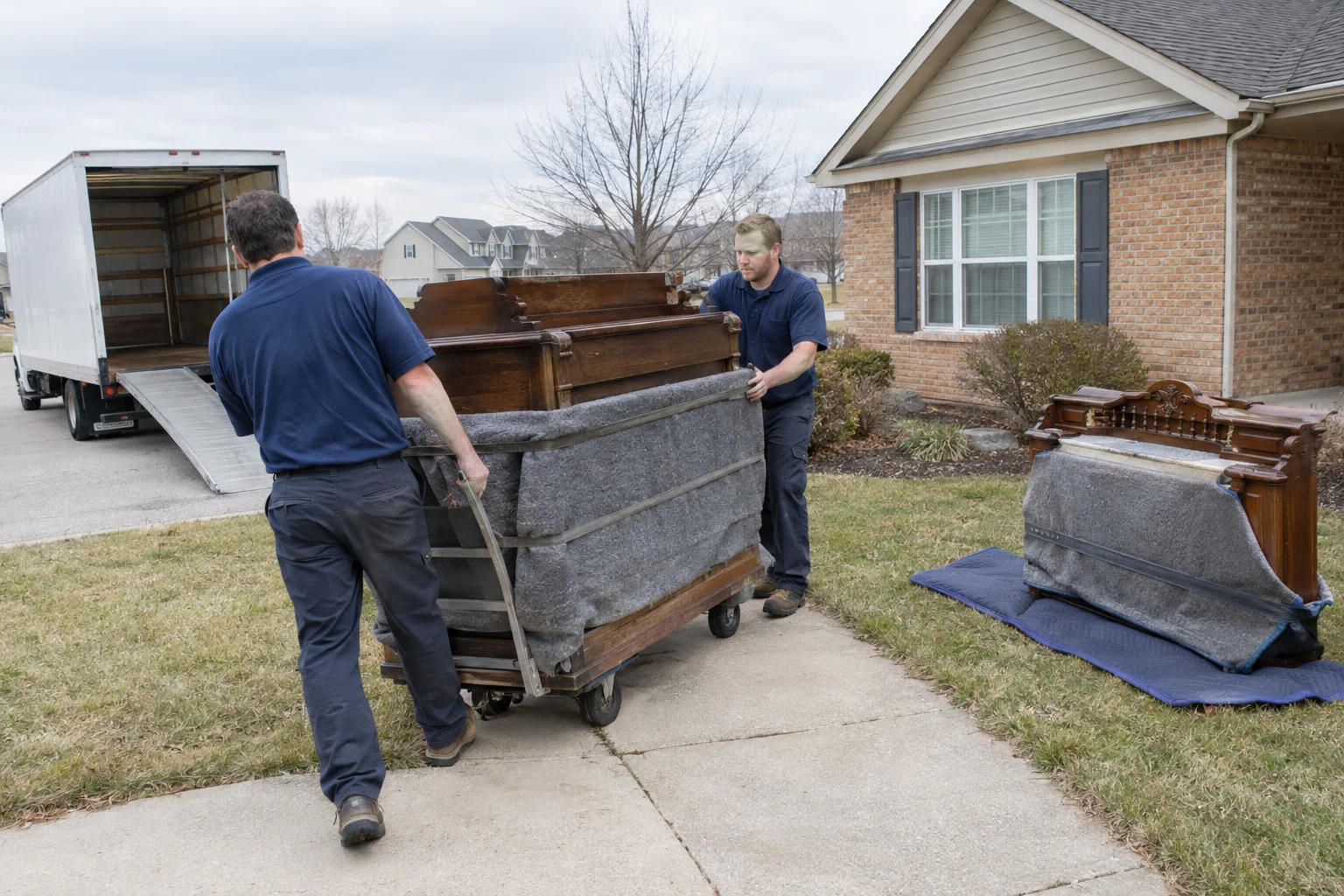
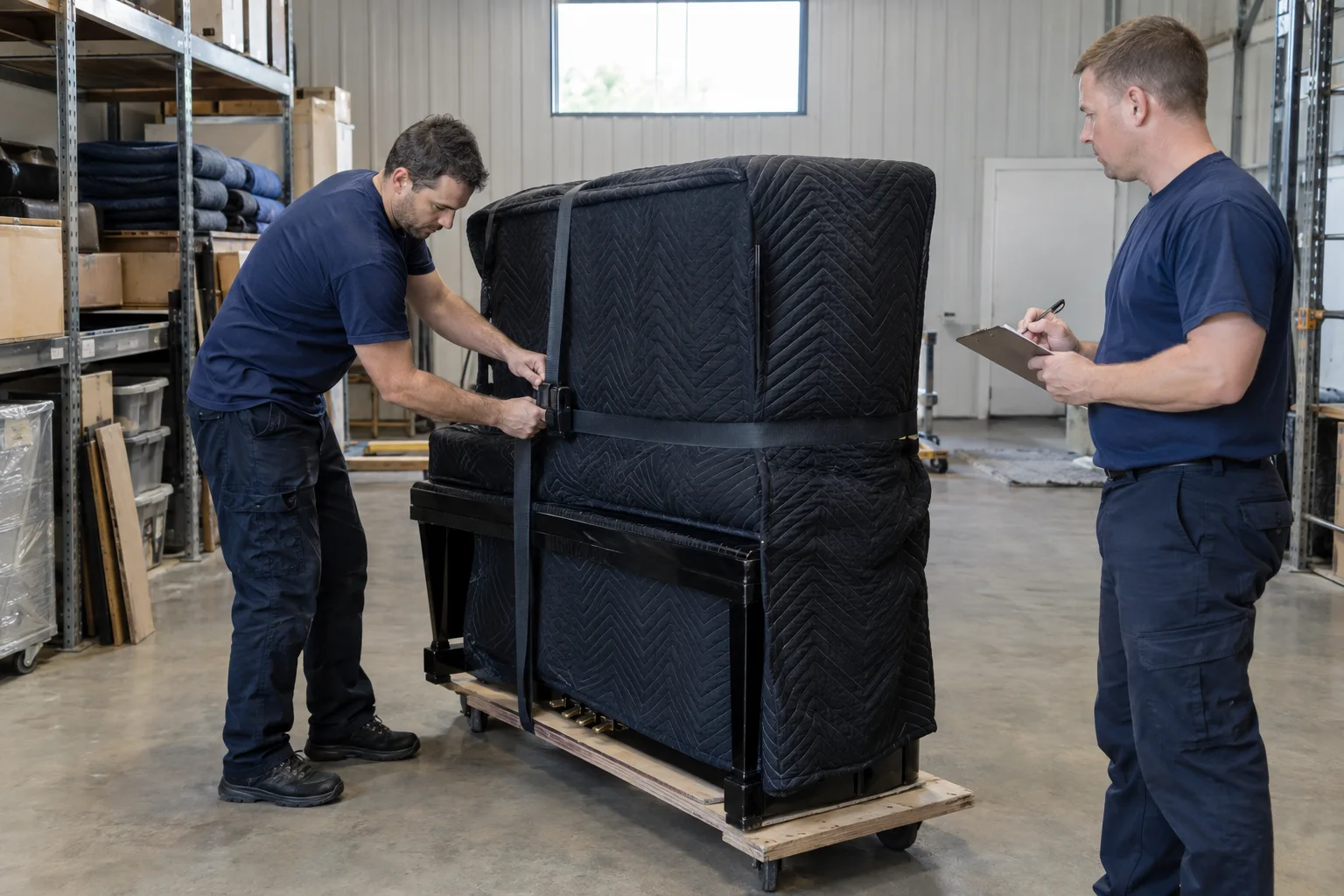
Current uprights from Kawai, Boston and Steinway weigh 424 to 661 pounds, with the weight sitting high and toward the back. Amenity Moving & Storage, which runs Yorkville Movers, moves uprights standing, padded and strapped to a dolly or skid board. On stairs, crew members work above and below the piano and take it down one step at a time.
- Pianos covered
- Spinets, consoles, studio uprights and full-size uprights
- Typical weight
- 424–661 lb for current Kawai, Boston and Steinway uprights
- Equipment
- Piano dolly or skid board, pads, blankets, lifting and tie-down straps
- Stairs
- Count every step, inside and outside, for the estimate
- Dispatched from
- Amenity’s Plainfield warehouse, about 10 miles east of Yorkville
Free moving estimate
Tell us where and when. Amenity’s office replies directly — no call centers.
Goes straight to Amenity Moving & Storage’s office. Never sold or shared with other movers.
On this page
Spinets, consoles, studios and full uprights compared
Every vertical piano moves the same basic way, but height and weight change how many hands a stair needs: the taller the piano, the higher its center of gravity and, usually, the heavier it is. The table uses manufacturers’ published figures for current models.
| Type (example model) | Height | Width × depth | Net weight |
|---|---|---|---|
| Console (Kawai 508) | 44½” | 59″ × 24″ | 424 lb |
| Upright (Kawai K-200) | 45″ | 59″ × 22½” | 459 lb |
| Studio upright (Boston UP-118E) | 46½” | 59¼” × 23½” | 553 lb |
| Full upright (Steinway K-52) | 52″ | 60″ × 26¾” | 650 lb |
| Full upright (Boston UP-132E) | 52″ | 60½” × 26¼” | 661 lb |
Notice how fast weight climbs with height. About 7½ inches separates the Kawai console from the Steinway K-52, yet the K-52 weighs 226 pounds more. A tall upright is a heavier, more top-heavy load on a stair than a console, even though both look like “a piano against the wall.”
Spinets, the shortest verticals, are lighter but not light, and their compact cabinets leave little to grip. They still go on a dolly with straps; nobody should lift a spinet by its lid or the narrow ends beside the keys.
Why uprights are harder to move than they look
An upright is harder to move than its size suggests because its weight sits high and toward the back, where the cast-iron plate and strings stand, so it tips more readily than a dresser of the same footprint. The narrow base that makes an upright fit against a wall is the same thing that makes it unstable on a slope or a stair.
The Piano Technicians Guild’s care rules tell owners to use only a professional piano mover, and an upright on a stair shows why. Once several hundred pounds start to lean, the only safe place to be is above it, and the only safe way to stop it is with straps and a board already in place.
What the crew brings
- A piano dolly or skid board, so the piano moves as one strapped unit.
- Pads and moving blankets for the case, plus bubble wrap where a finish needs it.
- Heavy-duty lifting straps for the carry and tie-down straps for the truck.
- Packing tape to hold blankets in place without touching the finish.

Moving an upright piano down stairs, step by step
An upright goes down stairs strapped to a board or dolly, with crew members below guiding and supporting it and crew members above holding it back, one tread at a time. Going up works the same way in reverse, with the pull coming from above.
- Measure the stairWidth, headroom at the top step, and the size of any landing or turn are checked against the piano’s height, width and depth.
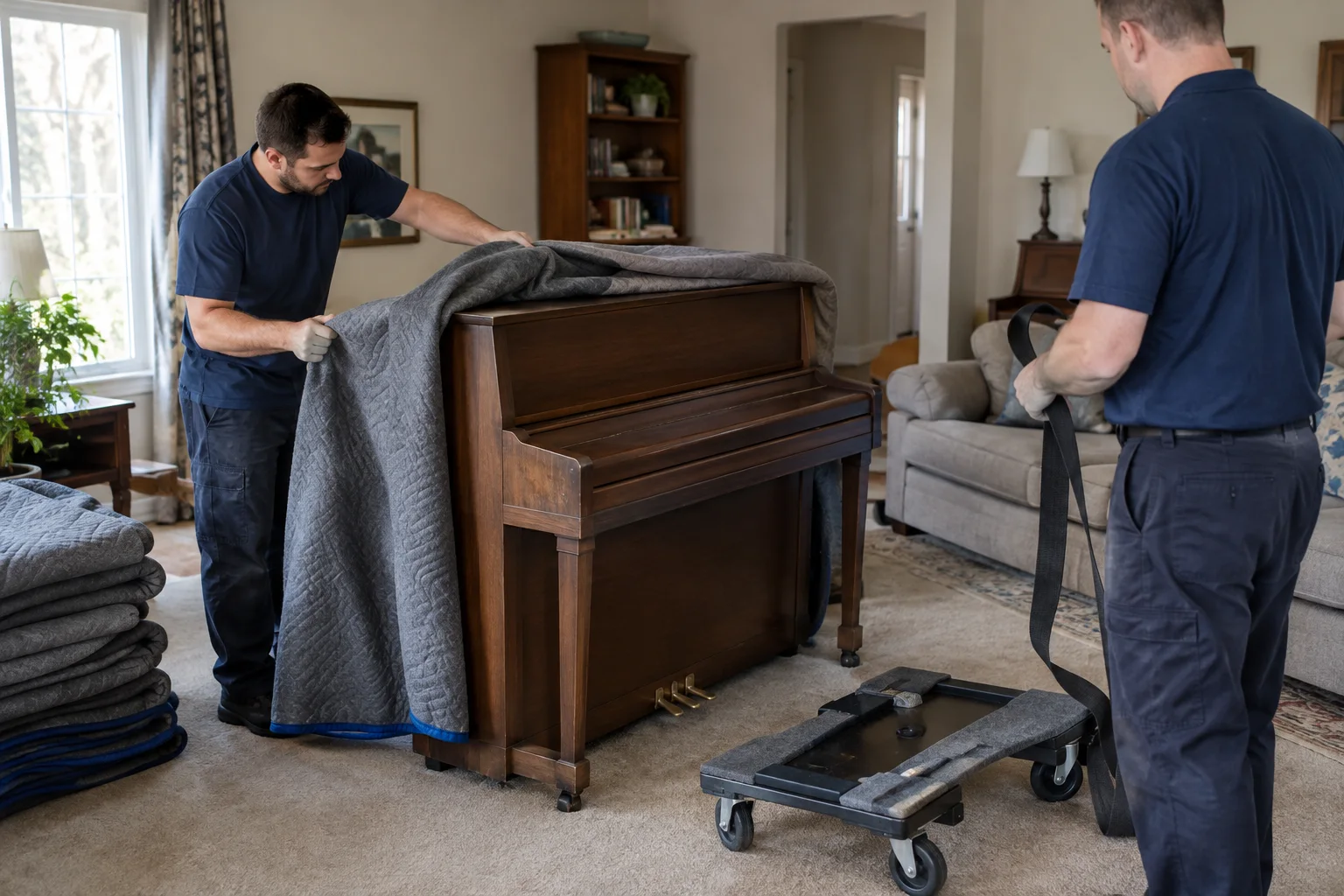
- Close and wrap the pianoThe fallboard is closed over the keys and the case is covered in pads and blankets, taped so nothing slips mid-stair.
- Strap it to the board or dollyHeavy-duty straps cinch the piano to its board so it can’t shift as the angle changes.
- Set the teamThe low side guides and supports, the high side controls the weight. Nobody stands directly in the piano’s path below.
- Take one step at a timeThe piano is eased down each tread on the board’s edge and never bounced, with a short pause at every step so everyone resets.
- Pivot at landingsAt a turn, the piano is pivoted on its board rather than spun on its own feet.
- Check the floor at the bottomBefore rolling on, the crew checks the threshold and flooring at the foot of the stair, then rolls the piano to the door or its new spot.
Keep the stair clear
On moving day, keep children and pets off the stairs and out of the hallway below while the piano is moving. Take rugs off the treads and landing, and leave the lights on in a basement stairwell.
Townhomes, split-levels and basements around Yorkville
The hardest upright moves around Yorkville are in homes where the piano lives on a different level from the door: townhomes with stacked floors, split-levels and finished basements. U.S. Census estimates show 64.2% of Yorkville’s housing units are single-family detached homes and 21.7% are single-family attached homes such as townhouses, so both kinds of stair show up often.
Townhome stairs tend to be the tighter of the two, with turns at a landing and less room at the top step. The apartment and townhome moving page covers the rest of a move in that kind of home. In a detached house, the challenge is usually the basement: a rec-room piano may have arrived before the stair was finished or through a door that has since changed, so a walk-out or patio door can be the better way out.
- How many steps on each staircase, and whether they’re inside or outside.
- Any landing turns, and how much room the landing gives.
- The narrowest point on the route, often a door at the top or bottom of a stair.
- Whether a walk-out, patio or garage door gives a level path to the driveway.
- Where the piano will stand at the new home, and what floor it’s on.
Amenity’s crews come from its Plainfield warehouse and move uprights throughout the area, including Plano and Minooka.
Planning a move in Yorkville?
Book a free, no-obligation estimate with Amenity’s office. One household per truck, licensed since 1986.
Protecting the piano, floors and walls
Protection on an upright move covers three things: the piano’s case and keys, the floors it rolls over, and the walls and door frames it passes. Pads and blankets go on the piano, door frames get padded at tight spots, and on winter moves Amenity lays floor runners.
In the truck, the piano is strapped in place with tie-down straps. On local moves Amenity puts one customer per truck, so the piano rides only with your own furniture.
Your part is quick. Take photos, candles and decorations off the top, empty the bench of sheet music so it travels light, and tell the estimator if the piano has a delicate antique finish or loose veneer. Don’t polish the case right before the move; PTG warns against aerosol polishes that contain silicone in any case.
Deciding whether an older upright is worth moving
An older upright is worth moving if it’s mechanically sound or matters to the family, and a technician’s inspection before the move tells you which. The PTG’s care FAQs say one piano may need rebuilding after just 20 years while another needs only reconditioning after 50, and that not every piano is worth the expense of either.
PTG also notes that most large, high-quality instruments can be rebuilt for one-half to two-thirds the cost of a comparable new piano, which is why a technician’s opinion on a tall upright from a respected maker carries more weight than its age alone.
If you’re sorting a parent’s house, the piano is often the biggest single decision on the list. The downsizing checklist for seniors and families and the guide to what to get rid of before you move help you decide early. Yorkville Movers moves pianos to a new home or into storage; if you decide not to keep one, ask a technician or dealer about your options.
Settling an upright into its new room
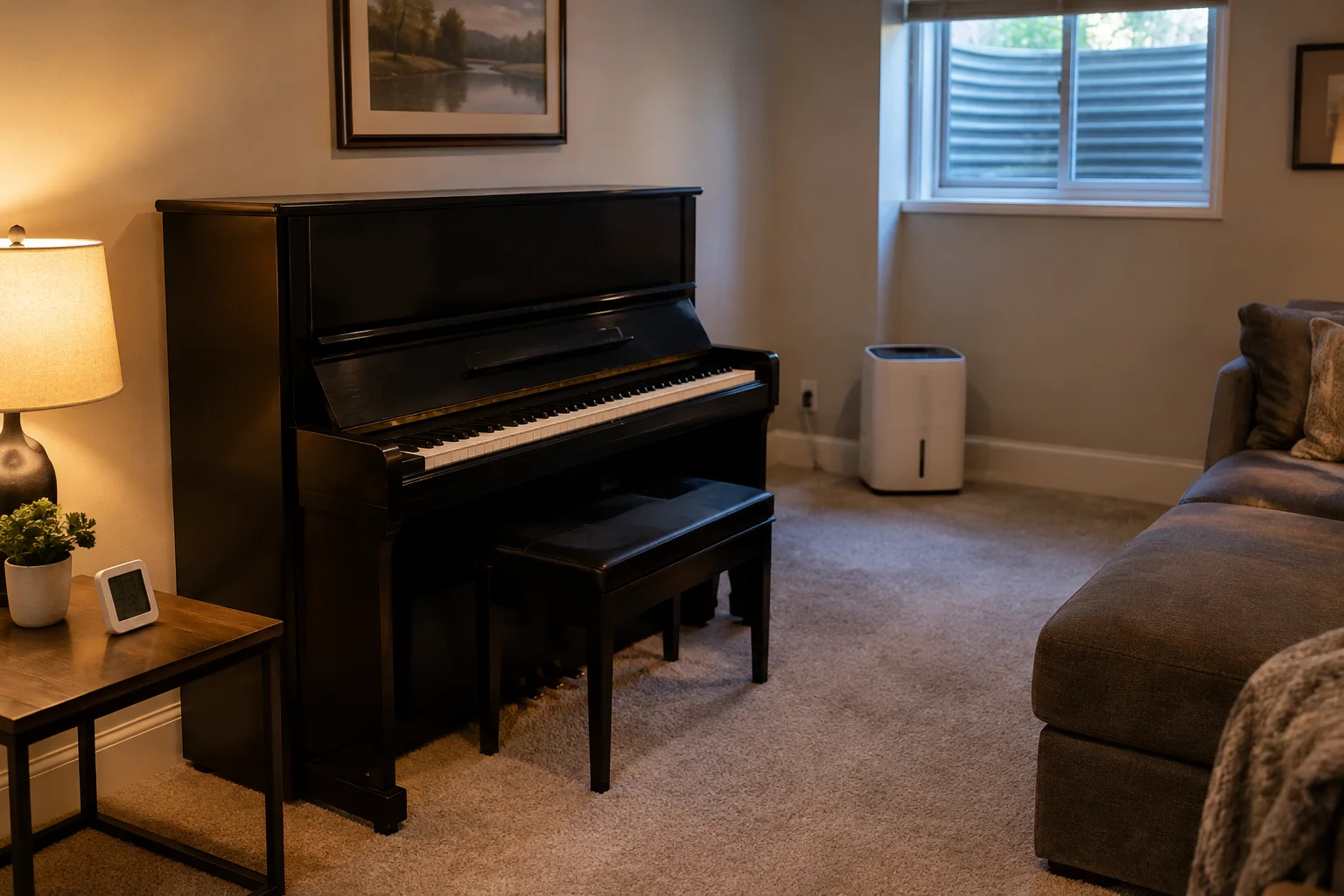
Set the upright against an interior wall away from vents, windows and direct sun, then let it settle for a few weeks before tuning, as Amenity suggests for any moved piano.
Finished basements deserve a hygrometer. The PTG’s humidity guidance names 42% relative humidity as the ideal level inside a piano, and Steinway recommends a room between 40% and 60%; a lower level that runs damp in July will push the pitch around. PTG suggests tuning often enough to hold pitch between A439 and A441, which usually means two to four tunings a year.
If the piano needs to wait between homes, piano storage keeps it in a climate-controlled facility. For other instruments in the house, see grand and baby grand piano moving or organ and pump organ moving, and the main piano moving page covers coverage and billing.
More piano moving services
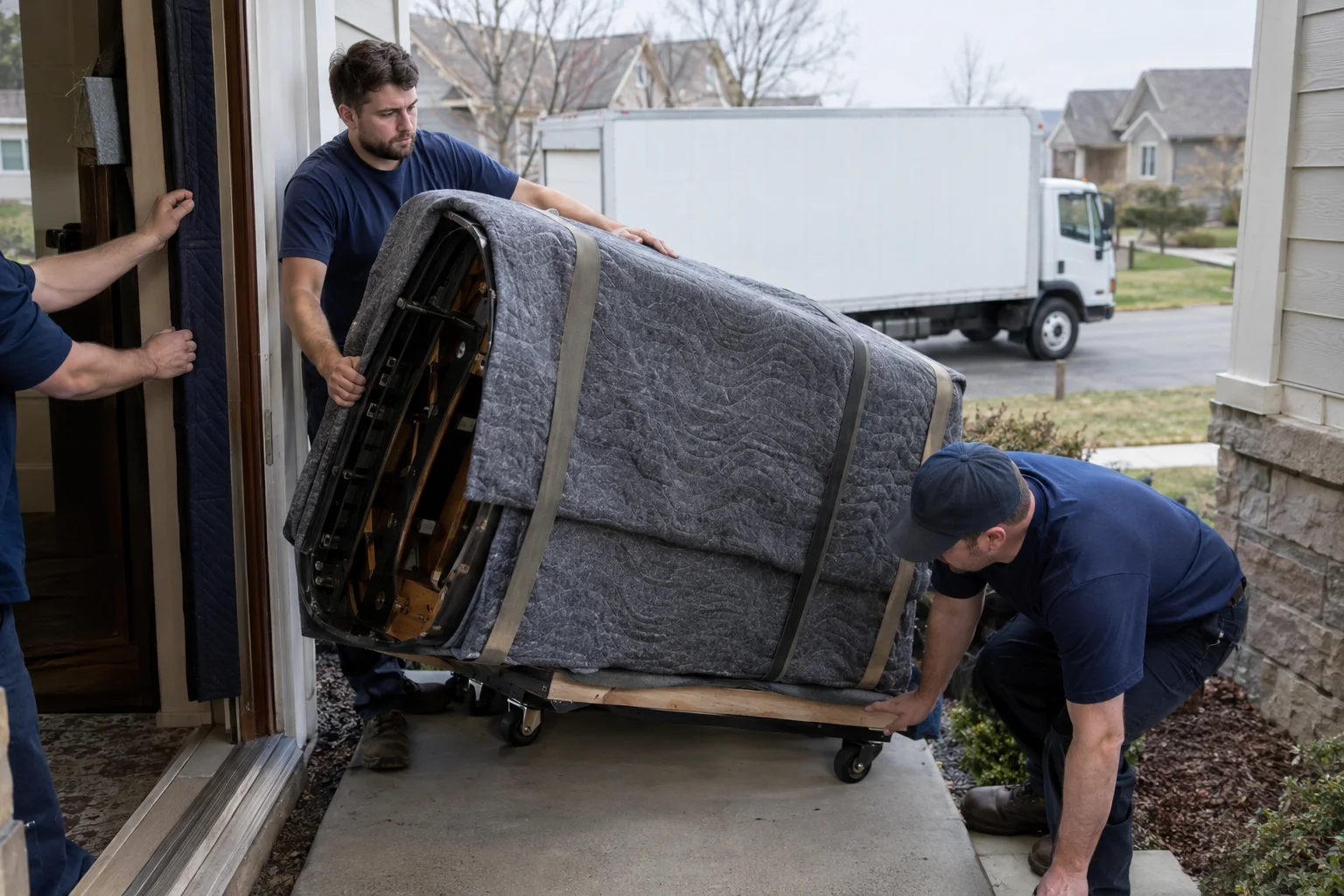 Grand & Baby Grand Piano MovingLegs and lyre removed, piano boarded on its sideLearn more →
 Organ & Pump Organ MovingHome organs and antique pump organsLearn more →
 Piano StorageClimate-controlled warehouse storage for pianosLearn more →
Back to Piano Moving in Yorkville · all moving services
Available across the Yorkville area
Frequently asked questions
How heavy is an upright piano?
Current uprights from major makers weigh roughly 420 to 660 pounds. Kawai lists its 44½-inch 508 console at 424 pounds, Boston lists its 46½-inch UP-118E at 553 pounds, and Steinway lists its 52-inch K-52 at 650 pounds. Taller uprights are generally heavier. Older pianos vary, so give the estimator the brand, model and height if you know them.
How many people does it take to move an upright piano?
It depends on the piano’s height and weight and on the stairs, so the estimator sets the crew after seeing the route. A console rolling across a ground floor needs fewer hands than a 52-inch upright coming up from a basement. On any stair, there should be people above and below the piano, and nobody standing in its path.
Can you move a piano down basement stairs?
Yes. The piano is padded, strapped to a board or dolly and taken down one tread at a time, with crew members above and below. Tell the estimator how many steps there are, whether there’s a landing turn, and how much headroom the top step has. If the stair is too tight or damaged, a walk-out or patio door may be the better route.
Is a spinet piano easier to move than a full upright?
Usually, because spinets are shorter and lighter, but they’re still heavy enough to need a dolly, straps and at least two people. Their small cabinets leave little to grip, and lifting one by the lid or the ends beside the keys can damage it. The bigger factor is still the route: a spinet down a turned basement stair is real work.
Should I empty the piano bench before the move?
Yes. Take sheet music and books out of the bench so it travels light and the lid can’t pop open, and pack them in a box. Clear photos, lamps and decorations off the top of the piano too. The crew pads and moves the piano and bench; everything else on or in them should already be packed.
What if my upright won't fit at the new house?
Measure first so it doesn’t come to that: the stair width, headroom at the top step and any landing turns at the new home. If a route is too tight, a different door, such as a walk-out or patio door, often solves it. If you need time to decide, Amenity can store the piano in its climate-controlled facility while you sort out the room.
Can you move a piano into a townhome?
Yes. Townhome moves usually come down to the stairs: their width, the turn at the landing and the room at the top step. Count the steps and measure the narrowest point before the estimate. If the piano is going to an upper floor, mention any railings or tight door swings so the crew can plan the route and equipment.
Sources
- Kawai 508 Decorator Console Upright Piano — Kawai America
- Traditional K-52 — Steinway & Sons
- Piano Care – Basic Rules — Piano Technicians Guild
- Piano Care – Care FAQs — Piano Technicians Guild
- Yorkville city, Illinois – Profile (ACS 2020–2024 5-year) — U.S. Census Bureau
Who handles your move
Yorkville Movers is operated by Amenity Moving & Storage Inc., 10028 Mandel St, Plainfield, IL 60585 — a family-run Illinois mover since 1986 whose crews dispatch to Yorkville and Kendall County from its Plainfield warehouse. Illinois household goods license ILCC 73744 MC-C. Interstate moves are transported under the authority of Wheaton Van Lines, Inc. (USDOT 70719, MC-87113), for which Amenity is an authorized agent. See licenses & disclosures.
Last reviewed November 11, 2026 by the Yorkville Movers team against Amenity Moving & Storage’s published service details and the public sources listed above.
Planning a move in Yorkville?
Book a free, no-obligation estimate with Amenity’s office. One household per truck, licensed since 1986.