Moving a gun safe to the basement or another room
Garage to basement, room to room, floor to floor: the stairs, floors and anchoring questions that decide how an in-home safe move goes.
- Garage to basement
- Power dollies
- Free in-home estimates
- ILCC 73744 MC-C licensed
How do you move a gun safe to the basement?
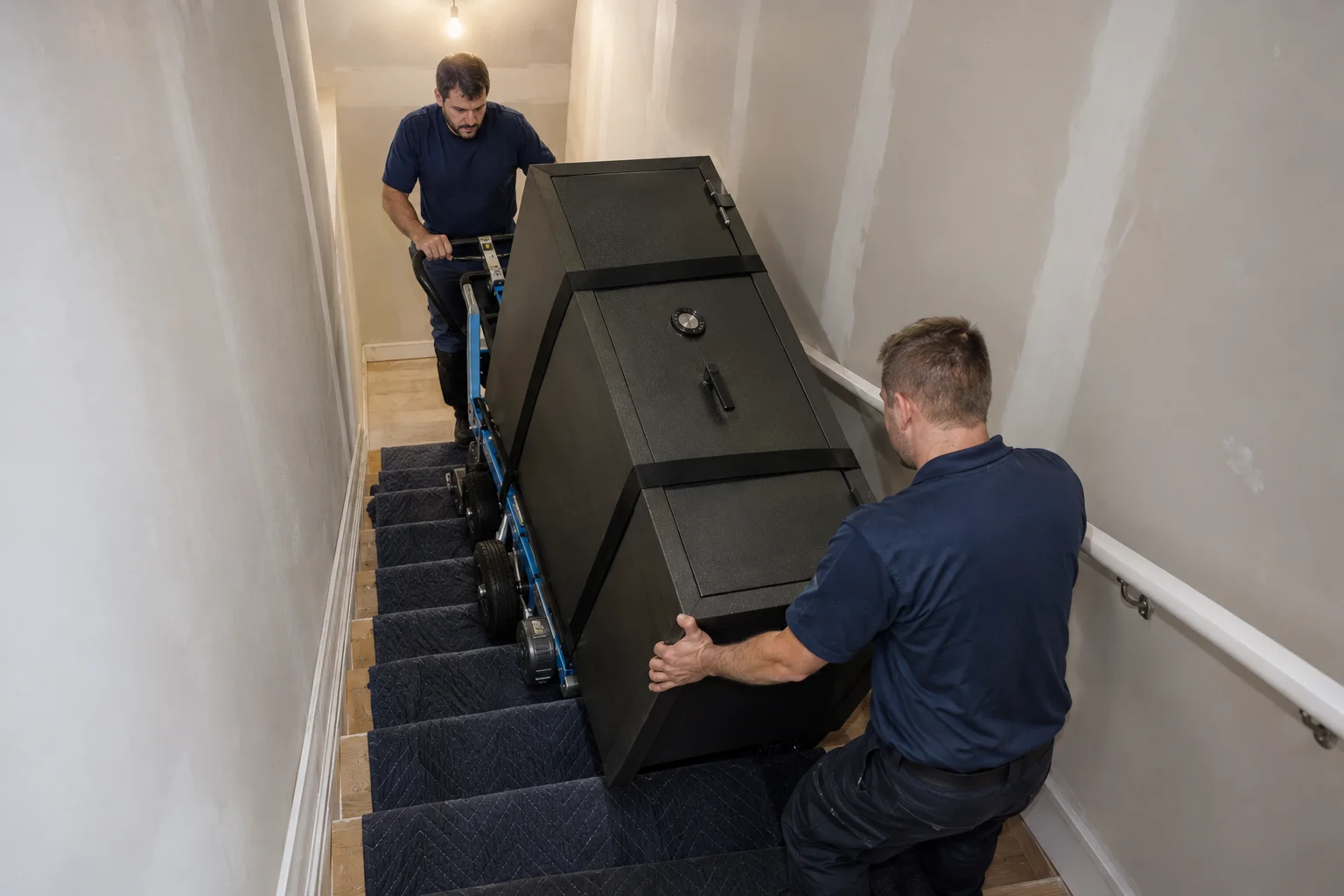
Empty and unbolt the safe, measure the stair and the turn at the bottom, then take it down one tread at a time on equipment rated for its weight, controlled from above and guided from below. Liberty Safe warns never to use a standard dolly on stairs. Yorkville Movers crews from Amenity Moving & Storage use power dollies and protect floors along the way.
- Typical moves
- Garage to basement, room to room, floor to floor
- Safe weights
- Roughly 300 to 2,000 lb, per Amenity
- Your prep
- Empty the safe; unbolt it or have Amenity unbolt it; clear the path
- Equipment
- Power dollies plus floor and wall protection
- Fire placement
- Liberty Safe recommends the basement or lowest level, against an outside wall
Free moving estimate
Tell us where and when. Amenity’s office replies directly — no call centers.
Goes straight to Amenity Moving & Storage’s office. Never sold or shared with other movers.
Why moving a safe inside the house is its own job
An in-home safe move is often harder than a house-to-house move, because nearly all of it is stairs, thresholds and tight turns. Amenity Moving & Storage, which operates Yorkville Movers, makes the point that a gun safe is a challenge even over a short distance, and that applies most here: one flight of basement stairs can take longer than the drive across town.
Yorkville homeowners usually call about an in-home move for one of a few reasons: a basement has just been finished, a new safe was dropped off in the garage, a remodel needs the space, or the owner wants the safe out of a garage that swings from summer heat to winter cold. Whatever the reason, the job is planned the same way: spot first, route second, equipment third.
The rules for the safe itself don’t change because it isn’t leaving the house. Amenity still asks you to empty it before the crew arrives, unbolt it or have Amenity unbolt it, clear the path and take up throw rugs that could catch dolly wheels. The main gun safe moving page covers safe weights, firearms rules and cost factors in full.
Choosing the new spot before anything moves
Choose the new spot first, because the floor under it decides how simple the move is: concrete basement floors and garage slabs carry a heavy safe most easily, while wood-framed floors and tile need more thought. Liberty Safe’s use and care guide recommends the basement or lowest level, against an outside wall, for fire protection.
| Spot | Floor | Anchoring (Liberty guidance) | Notes |
|---|---|---|---|
| Unfinished basement | Concrete slab | Concrete anchors set with a hammer drill | Liberty’s preferred spot for fire protection; add a moisture barrier |
| Finished basement | Concrete under flooring | Concrete anchors; plan around the finished floor | Check the stair and the turn at the bottom |
| Garage | Concrete slab | Concrete anchors | Wider temperature and humidity swings |
| Main or upper floor | Wood subfloor | Wood-subfloor anchoring kit | A concentrated load on the framing |
| Tile floor | Tile over a base | Liberty says a safe can’t be anchored to tile | Pick another spot, or plan the anchoring another way |
In a detached single-family house, the type that makes up 64.2% of Yorkville’s housing according to U.S. Census estimates, the usual candidates are the garage, the basement and a main-floor room or closet. If the basement runs damp, Liberty’s advice to keep a safe away from excessive humidity and to put a moisture barrier under it matters more than the view from the stairs.
Pick a backup spot too. Amenity’s own checklist suggests a plan B, because the first choice sometimes turns out not to work once the safe is in the room: a door that can’t open fully against a wall, an outlet or floor register in the way, or flooring that shouldn’t be drilled.

Taking a safe down basement stairs, step by step
A safe goes down basement stairs strapped upright to equipment rated for its weight, controlled from above and guided from below, one tread at a time. Liberty Safe’s Safe Relocation 101 says never to attempt it with a standard dolly and to keep the safe upright throughout.
- Empty the safe and close the doorEverything comes out first, and the door is closed and locked so it can’t swing open mid-stair. Keep the combination or key with you.
- Unbolt itFloor bolts come out before moving day or at the start of the job, with the safe steadied as the last bolt is removed.
- Measure the stairWidth, headroom over the top step and the space to turn at the bottom are checked against the safe’s height, width and depth, plus the dolly.
- Check the treadsCracked, loose or soft treads change the plan before the safe ever reaches them.
- Protect the routeBoards or thick blankets go over floors, and pads go on door frames and wall corners along the way.
- Strap it to the dollyThe safe is strapped upright to a power dolly so it moves as one unit.
- Descend one tread at a timeThe crew controls the weight from above while a crew member guides from below, never standing directly in the safe’s path.
- Set it on its spotAt the bottom, the safe is rolled to its spot and set down on any moisture barrier you’ve laid out, ready for anchoring.
Why the treads matter
Model residential code designs stair treads for a uniform 40 pounds per square foot or a 300-pound concentrated load over 4 square inches, whichever is worse (IRC Table R301.5, as adopted in WAC 51-51-0301). A heavy safe on a dolly rests on one or two treads at a time, which is why a damaged or soft tread is a reason to stop and rethink, not push through.
Room to room and floor to floor
Moving a safe between rooms on one floor is mostly about thresholds, turns and the floor surface; moving it up a floor adds a stair and the question of whether the framing suits a concentrated load. Both start with a clear path and protected floors.
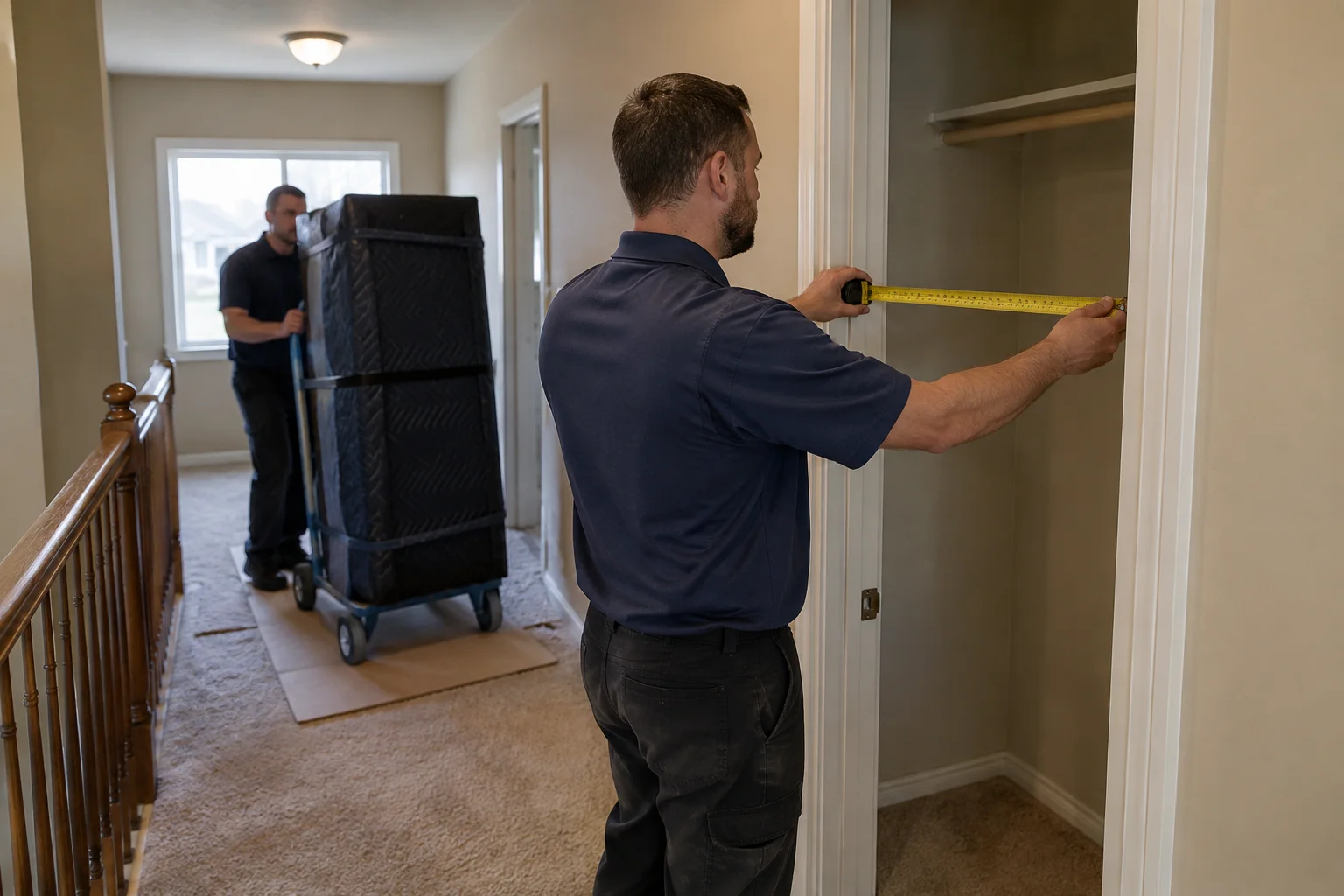
On the same floor, Liberty suggests plywood, hardboard or thick moving blankets under the route and padding on walls and door frames. Thresholds and the edges where hardwood meets tile or carpet are where wheels catch, so those spots get a board. Measure the turn into the room, not just the doorway: a safe that clears a 32-inch door straight on may not clear it after a tight turn out of a hall.
Upstairs is where to slow down. Model residential code sizes sleeping rooms for an average live load of 30 pounds per square foot. A 600-pound safe on a 2-by-2-foot base puts 150 pounds on each square foot under it. That concentration isn’t automatically a problem, since framing spreads loads and floors carry margins, but it’s a good reason to ask your builder or a structural engineer before a heavy safe goes into a bedroom closet.
Closets bring one more check: the safe’s door. Measure the room the door needs to swing open fully once the safe is against the wall, and leave space to reach the dial or keypad. A safe that fits the closet but can’t open is a safe that will be moved twice.
Planning a move in Yorkville?
Book a free, no-obligation estimate with Amenity’s office. One household per truck, licensed since 1986.
Unbolting and re-anchoring
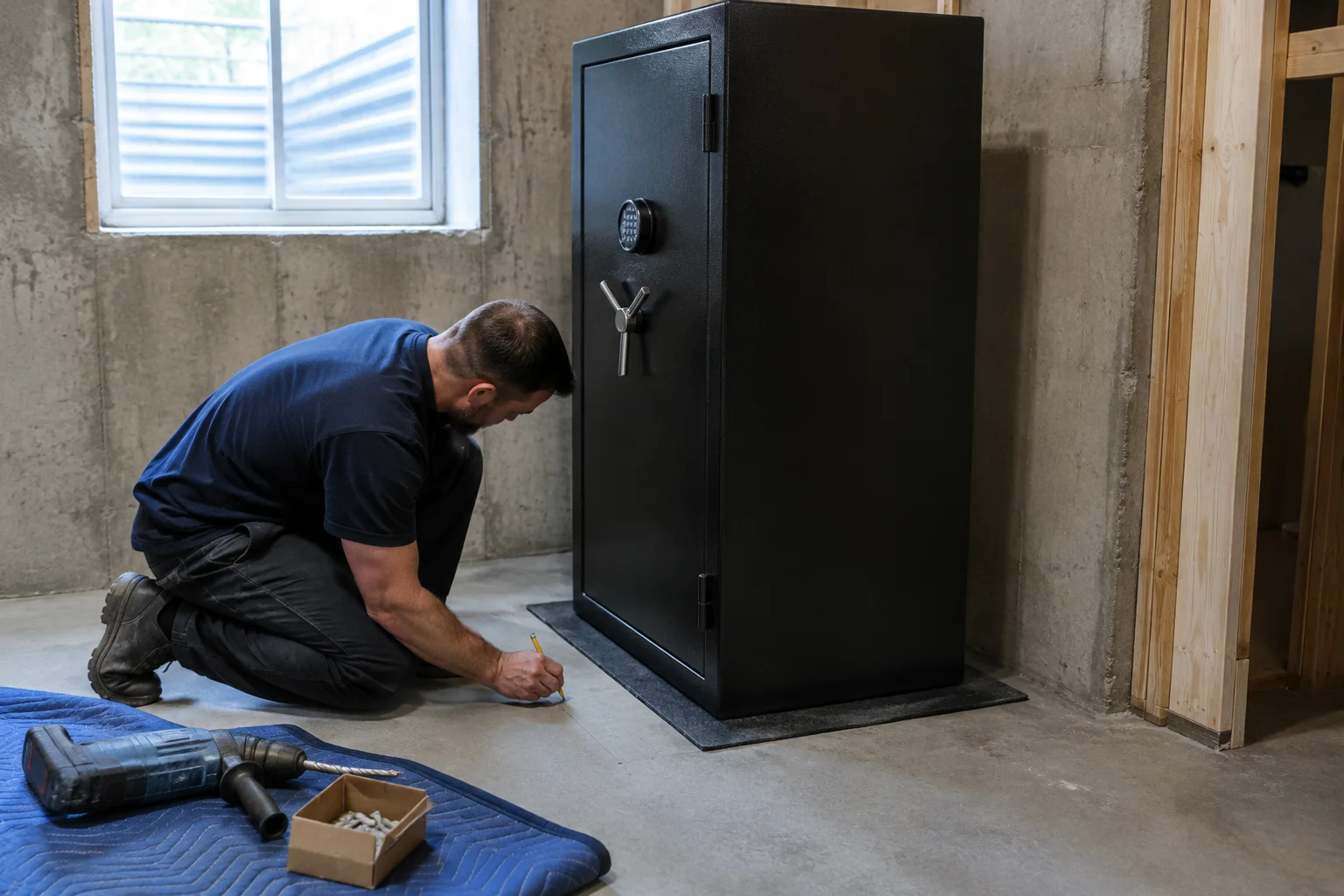
A bolted safe has to be unbolted before it moves, by you or by Amenity, and it should be anchored again at the new spot. Liberty Safe’s guide to anchoring your gun safe to the floor says you should always anchor a safe, because anchoring helps prevent damage to your home and accidents that could cause injury.
- Concrete (basement or garage): Liberty calls for a concrete anchoring kit and a hammer drill, with holes at each of the safe’s four anchoring locations.
- Wood subfloor: Liberty sells a wood-subfloor anchoring kit, with holes drilled at the four anchoring locations through the floor into the subfloor.
- Tile: Liberty says you can’t anchor a safe to a tile floor, because bolting it down can crack the tile.
- Other brands: follow your safe’s own manual for hardware and hole locations.
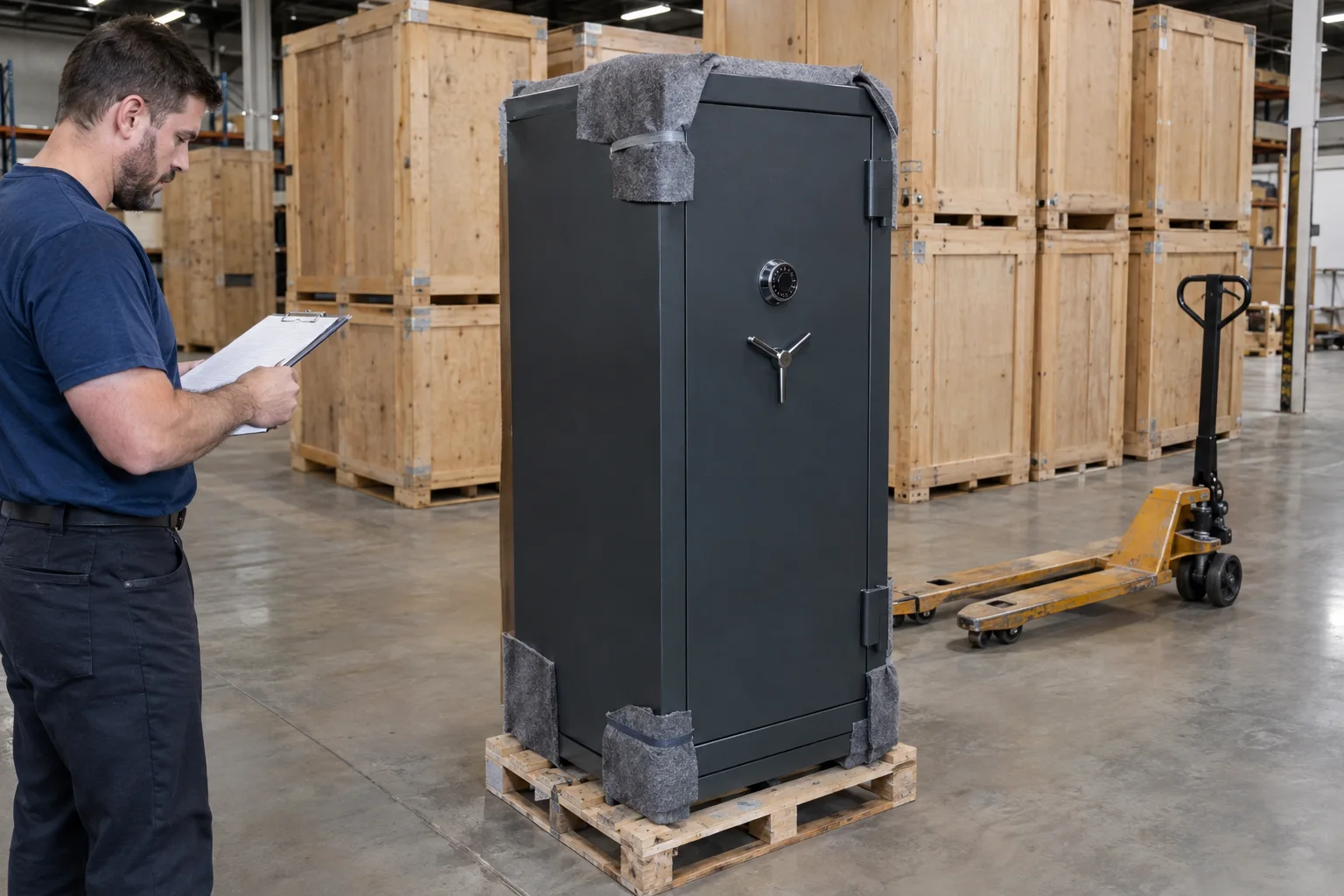
Tell the estimator whether the safe will be bolted down at the new spot so the day can be planned around it, and patch the old holes in the slab or subfloor once the safe is gone. If the safe is new and still on its shipping pallet, mention it: Liberty’s care guide says to slide a safe off its pallet carefully to avoid scratching floor surfaces, and the estimator can plan for that step.
What makes an in-home safe move take longer
Stairs, the number of thresholds and turns, and whether the safe is bolted at either end decide how long an in-home safe move takes. Distance inside the house barely matters by comparison.
| Move | What adds time |
|---|---|
| Room to room, same floor | Thresholds, turns and floor protection only |
| Garage to basement | Garage step into the house, a hallway, then the full basement stair |
| Main floor to basement | The basement stair and the turn at the bottom |
| Main floor to upper floor | Stairs going up, plus framing questions for heavy safes |
| Into a closet | Door width, the turn into the closet and room for the safe’s door to swing |
| Bolted at both ends | Unbolting before the move and anchoring after |
Crews come from Amenity’s Plainfield warehouse, about 10 miles east of Yorkville, and handle in-home safe moves around the area, including Oswego, Montgomery and Plano. If the safe is going into a newly built house, new-construction home moves explains timing around closings and unfinished drives, and if it has to wait somewhere first, see safe storage.
For the rest of the house, the 8-week moving checklist and the guide to what movers won’t move or pack cover the items, including firearms and ammunition, that you’ll handle yourself.
More gun safe moving services
Back to Gun Safe Moving in Yorkville · all moving services
Available across the Yorkville area
Frequently asked questions
Can movers move a gun safe down basement stairs?
Yes, when the stair is wide enough and sound enough, and the safe is empty and unbolted. Amenity’s crews use power dollies and protect the floors and walls along the route. Count the steps, measure the stair width and the space to turn at the bottom, and mention any damaged treads when you book so the plan fits your stair.
How do you move a safe down stairs without damaging them?
Protect the route and check the treads first. Boards or thick blankets go over floors, pads go on door frames and corners, and the safe moves one tread at a time on equipment rated for its weight, never bounced. Liberty Safe warns against using a standard dolly on stairs. A cracked or soft tread is a reason to change the plan.
Is the basement a good place for a gun safe?
Often, yes. Liberty Safe recommends the basement or lowest level, against an outside wall, for fire protection, and a concrete floor carries a heavy safe well. The trade-off is moisture: Liberty says a safe shouldn’t be exposed to excessive humidity and suggests a moisture barrier under it. A dehumidifier helps in a damp basement.
Should a gun safe be bolted down after it's moved?
Yes. Liberty Safe says you should always anchor a safe to the floor, because anchoring helps prevent damage and accidents. Use concrete anchors on a basement or garage slab and a wood-subfloor kit on framed floors, following your safe’s manual. Liberty says a safe can’t be anchored to tile, so choose a Yorkville basement or garage spot with anchoring in mind.
Can I move a safe within my house myself?
Liberty Safe never recommends moving a heavy safe on your own. If you try a short, level move, Liberty’s advice is a heavy-duty appliance dolly rated for at least 800 pounds, at least three helpers, padded blankets and no force on the handle. Stairs are where do-it-yourself moves go wrong, so leave any stair work to a crew.
How do I get a new gun safe into my basement?
If a new safe was dropped off in your garage or driveway, the move into the basement is a standard in-home job: it’s already empty, so measure the route, choose the spot and decide how it will be anchored. Liberty’s care guide says to slide a safe off its pallet carefully to avoid scratching floors. Give the estimator the make, model and weight.
Can a gun safe go on a second floor?
It can, but plan carefully. The stair has to be wide and sound enough, and the floor has to suit a concentrated load: model residential code sizes bedrooms for an average 30 pounds per square foot, and a heavy safe concentrates far more on its footprint. Ask your builder or a structural engineer before placing a heavy safe upstairs.
Sources
- Safe Relocation 101: Tips for Moving Your Liberty Safe Safely — Liberty Safe
- Anchoring Your Gun Safe to the Floor — Liberty Safe
- Gun Safe Use and Care — Liberty Safe
- WAC 51-51-0301 (IRC Section R301, Table R301.5) — Washington State Legislature
- Yorkville city, Illinois – Profile (ACS 2020–2024 5-year) — U.S. Census Bureau
Who handles your move
Yorkville Movers is operated by Amenity Moving & Storage Inc., 10028 Mandel St, Plainfield, IL 60585 — a family-run Illinois mover since 1986 whose crews dispatch to Yorkville and Kendall County from its Plainfield warehouse. Illinois household goods license ILCC 73744 MC-C. Interstate moves are transported under the authority of Wheaton Van Lines, Inc. (USDOT 70719, MC-87113), for which Amenity is an authorized agent. See licenses & disclosures.
Last reviewed November 11, 2026 by the Yorkville Movers team against Amenity Moving & Storage’s published service details and the public sources listed above.
Planning a move in Yorkville?
Book a free, no-obligation estimate with Amenity’s office. One household per truck, licensed since 1986.