
Office movers in Yorkville, IL
Desks, cubicles, computers and copy machines moved by Amenity Moving & Storage crews, with color-coded placement and a free in-person estimate before anything is booked.
- Moving since 1986
- ILCC 73744 MC-C
- Free in-person estimate
- Desks & cubicles rebuilt
Who handles office and commercial moves in Yorkville, IL, and what do they cover?
Yorkville Movers is the Yorkville-area brand of Amenity Moving & Storage, a family-run Plainfield mover in business since 1986 and licensed by the Illinois Commerce Commission (ILCC 73744 MC-C). For offices, its crews take apart and rebuild desks and cubicles, move computers, copy machines and fragile furniture, pack, rent boxes and color-code every item for placement. Every job starts with a free in-person estimate.
- Operated by
- Amenity Moving & Storage Inc., Plainfield, IL (since 1986)
- Licensed by
- Illinois Commerce Commission, ILCC 73744 MC-C
- Office work
- Desk and cubicle disassembly and reassembly, computers, copiers, fragile furniture
- Planning tools
- Color-coding for placement, box-rental program, packing services
- Estimate
- Free, in person, from a visual evaluation of your space
- Dispatch
- Amenity’s Plainfield warehouse, about 10 miles east of Yorkville
Free moving estimate
Tell us where and when. Amenity’s office replies directly — no call centers.
Goes straight to Amenity Moving & Storage’s office. Never sold or shared with other movers.
On this page
What Amenity's office movers handle for local businesses
Amenity Moving & Storage, the company behind Yorkville Movers, handles the physical side of an office or commercial move: furniture, workstations, equipment, files and boxes, carried out of the old space and set up in the new one. The office service rests on six pieces of work.
- A free in-person estimate built from a visual evaluation of your furniture, equipment and building access.
- Desk and cubicle disassembly and reassembly, from L-shaped desks and returns to full cubicle runs.
- Computers and copy machines, handled by crews with office-equipment experience.
- Fragile office furniture such as glass-top tables, wood conference tables and reception pieces, wrapped in furniture pads.
- Color-coding so every carton, chair and machine lands in the right room.
- A box-rental program and packing services for files, supplies and break-room contents.
Just as useful is knowing what sits outside the crew’s job. Disconnecting and reconnecting computers, networks, phones and security systems belongs to your IT provider. Hardwired cubicle power, wall-mounted screens and changes to the building belong to your electrician, landlord or contractor. Settle that split early and moving day doesn’t stall while someone hunts for a technician.
Amenity has moved households and businesses since 1986 from its warehouse at 10028 Mandel St in Plainfield, about 10 miles east of downtown Yorkville. There is no separate storefront here; estimators and crews come from Plainfield.
Three services inside every business relocation
Most business relocations break into three kinds of work, and each has its own page with deeper detail.
Office furniture and cubicle moving
Workstations are the bulk of most office moves. Crews take apart desks, returns and cubicle runs, pad the panels and worksurfaces, and rebuild each station to your floor plan. Amenity moves furniture with its own personnel, not subcontractors or temporary labor. The teardown-to-rebuild sequence is on office furniture and cubicle moving.
Computer and copier moving
Computers, monitors, printers and copy machines need different handling from furniture, and a copier lease is worth reading before anything rolls. Computer and copier moving explains how to divide the work between your IT provider, your copier dealer and the crew.
Business relocation planning
Color-coding, the box-rental program and a plan written before moving day keep thirty desks from turning into one pile in a hallway. Business relocation planning covers lead times, labeling, floor plans and storage when lease dates don’t line up.

Illinois law counts office furniture as household goods
Illinois law counts the furniture, fixtures and equipment of offices, stores and similar establishments as household goods, so anyone hired to move them within the state needs the same license as a residential mover. The definition sits in 625 ILCS 5/18c-1104, subsection (13.1)(B).
The Illinois Commerce Commission requires a Household Goods License for anyone who moves household goods for hire, and each licensed mover must publish and file a tariff listing its services and prices. Amenity holds Illinois license ILCC 73744 MC-C; the licenses and disclosures page has the details, and the ICC’s licensed-mover search lets you confirm any company before you sign.
| Question | What the rule says | Source |
|---|---|---|
| Is office furniture household goods in Illinois? | Yes. Furniture, fixtures and equipment of offices, stores and other establishments are included. | 625 ILCS 5/18c-1104 (13.1)(B) |
| Does an Illinois office mover need a license? | Yes. An ICC Household Goods License plus a filed tariff. | Illinois Commerce Commission |
| What must an Illinois estimate look like? | An Estimate of Charges form, based on an in-person or virtual inspection. | 92 Ill. Adm. Code 1457.610 |
| How are moves inside Kendall County billed? | Moves under 50 miles, or entirely within Cook, DuPage, Kane, Kendall, Lake, McHenry and Will counties, may be billed by workers and hours. | ICC Consumer Guide (rev. 3/2026) |
| Do federal interstate consumer rules cover office contents? | Federal rules define household goods as property used in a dwelling and apply to individual shippers. | 49 CFR 375.101 and 375.103 |
The federal difference matters only if your business is leaving Illinois. The interstate consumer rules in 49 CFR Part 375 are written for individual shippers moving property used in a dwelling, so a company shipping an office across state lines should read the bill of lading and liability terms closely and raise it at the estimate.
How the free on-site estimate works for a business
An Amenity estimator visits your current space, looks at every workstation, cabinet and machine, checks how the crew will get in and out, and then gives you a written estimate. Nothing is booked until you have that document.
- Book the walk-throughGive both addresses, including floor, suite number and whether either building has a loading dock or freight elevator.
- Walk the space togetherThe estimator counts workstations, cubicle panels, file cabinets, copiers and conference furniture. Point out anything that is staying behind.
- Talk through the new spaceBring the new floor plan or a sketch. Truck-to-door distance, stairs and elevator rules at the destination all change crew size and hours.
- Get the estimate in writingIllinois requires an Estimate of Charges form; for an hourly move it shows estimated hours, including travel time, under 92 Ill. Adm. Code 1457.610.
- Compare like with likeIf you collect several bids, check that each covers the same scope: disassembly and reassembly, packing, materials and crew size.
The ICC’s consumer guide is blunt that an Illinois estimate is not binding, so the final bill follows the actual hours. It also sets a safety valve: pay 110% of the written estimate at delivery and the mover must give you 30 days to pay any balance. For more on what an estimator checks, read what happens at an in-home moving estimate.
Planning a move in Yorkville?
Book a free, no-obligation estimate with Amenity’s office. One household per truck, licensed since 1986.
What sets the hours on an office moving day
Because moves inside Kendall County and its neighboring counties may be billed by workers and hours, the cost of an office move tracks how long the crew needs, and six factors decide most of that time.
| Factor | Why it adds time | How to trim it |
|---|---|---|
| Number of workstations | Each desk or cubicle is taken apart, wrapped, loaded and rebuilt. | Decide early which furniture stays behind or is replaced. |
| Building access | Long walks from the dock, shared elevators and stairs slow every trip. | Reserve elevators and docks at both buildings. |
| Packing readiness | The crew waits if desks and supply rooms are still being packed. | Set a staff packing deadline the day before. |
| Equipment prep | A copier or server that isn’t ready can hold up a load. | Have your IT provider and copier dealer finish first. |
| Labeling | Unlabeled boxes get stacked in one room and sorted later. | Put the color code on every carton, chair and machine. |
| Drive between buildings | Travel time counts on an hourly move. | Ask how the estimate handles drive time and truck count. |
Truck size matters too. Amenity runs multiple truck sizes and can bring full semi trailers when fewer trips save time, and on local moves each truck carries one customer’s goods only, so your files never share space with another household or business.
For the general mechanics of hourly billing, see how moving costs work. This site doesn’t list office rates, because two offices with the same headcount can differ by hours of work.
Truck routes, industrial areas and permits in Yorkville
Three local factors shape a business move here: the city’s designated truck routes, the industrial areas it has mapped, and the commercial occupancy permit a new tenant needs.
The city’s industrial development page lists Route 47, Route 34, Route 71 and Route 126 as Class II truck routes, with smaller Class III routes along Eldamain Road and inside Fox Industrial Park. Route 47 gives direct access to I-88. The same page names three areas where industrial and manufacturing property exists or may develop: Fox Industrial Park, the Yorkville Business Center and the Eldamain corridor. Designated routes reach the main roads; the final approach to your loading door is what the estimator should check.
A new business moving into an existing commercial space needs a commercial occupancy permit, according to the city’s building permit applications page; so does a change in operations that changes land use. If you are already filing a commercial permit to build or alter the space, a separate occupancy application isn’t required. Build the approval into your timeline before you lock in a move date.
Amenity’s crews also move businesses in neighboring communities such as Oswego, Montgomery and Plano, all reached from the warehouse in Plainfield. Each town has its own permit office, so check the local rules the same way.
Packing, box rental and storage between leases
Amenity can pack the whole office or only the hard parts, rent you boxes for the rest, and hold furniture in its Plainfield warehouse if the new lease starts after the old one ends.
Packing is done by specialists separate from the moving team, using specially sized cartons, padding and custom crating for fragile and valuable pieces, with each container labeled by contents and destination room. A split that works for many offices: staff pack their own desks while packers take the break room, supply closet, framed art and anything glass. See packing services.
The box-rental program covers the cartons your team packs itself; ask at the estimate which sizes are included. Amenity also collects emptied containers after a move, with some limitations.
Storage fills the gap when a build-out or lease date slips. Amenity’s 12,000 sq ft climate-controlled warehouse holds furniture wrapped in pads and cardboard, then sealed in wooden crates measuring 8′ x 7.5′ x 5′, with every item entered in an inventory database. Only Amenity personnel enter the building; it is not drive-up self-storage. More on moving and storage.
Getting staff and vendors ready before the truck arrives
An office move runs fastest when every desk is packed, every machine has been prepared by its own technician, and both buildings have the move on their calendars before the crew pulls in.
- Name one internal move coordinator who can answer the crew’s questions at both addresses.
- Get each building’s move rules in writing: elevator reservations, dock times, floor protection and any certificate of insurance the landlord expects from the mover.
- Ask your IT provider to schedule disconnects and reconnects around the truck times.
- Read the copier lease or service agreement and call the dealer about transport.
- Have an electrician disconnect any hardwired cubicle power before teardown.
- Give each employee boxes, labels and a packing deadline; laptops and personal valuables travel with their owners.
- Post the color code and a numbered floor plan at each door in the new space.
In winter, Amenity lays floor runners and, when weather turns, can change dates subject to availability. The full timeline is in the office move checklist. A small suite with a few desks follows the same steps through Amenity’s local moving service.
Office & Commercial Moving services
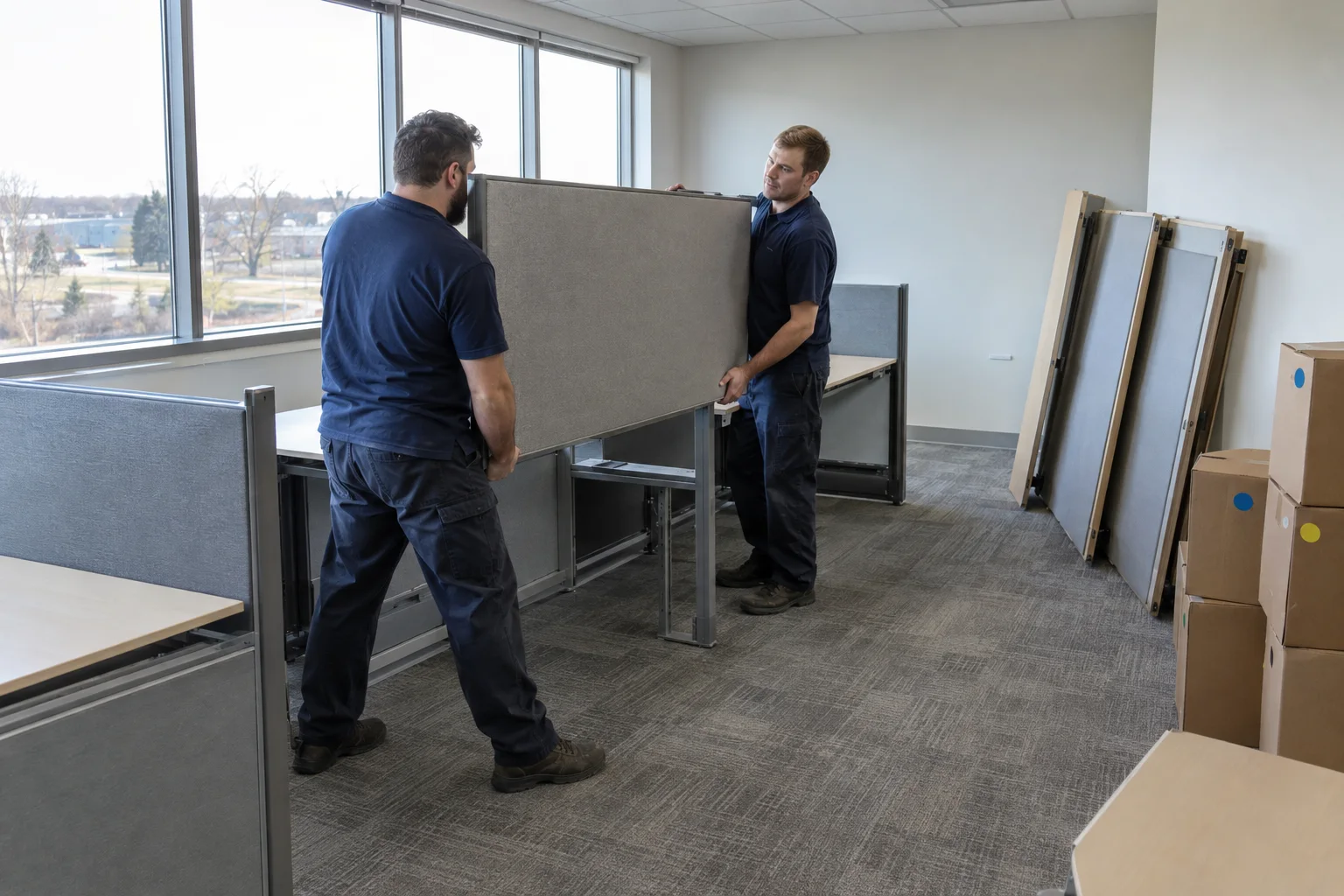 Office Furniture & Cubicle MovingDesks and cubicles taken apart, moved and rebuiltLearn more →
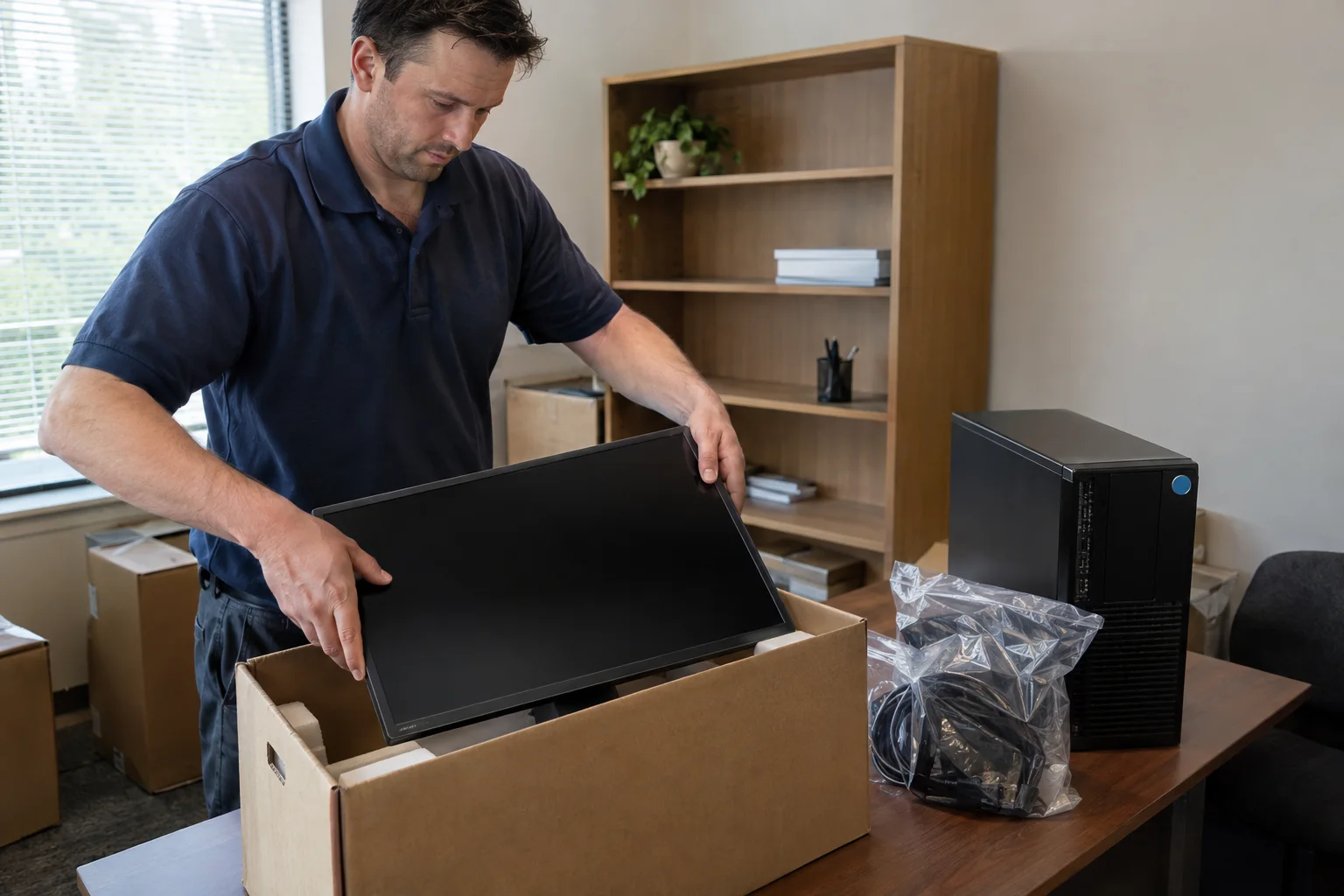 Computer & Copier MovingCareful handling of computers, copiers and fragile equipmentLearn more →
 Business Relocation PlanningColor-coding, box rental and a plan built before moving dayLearn more →
Where we provide office & commercial moving
- Yorkville
- Oswego
- Montgomery
- Plano
- Sugar Grove
- Big Rock
- Plainfield
- Sandwich
- Aurora
- North Aurora
- Newark
- Shorewood
- Minooka
Related moving services
 Local MovingHome moves in and around Yorkville, one household per truckLearn more →
 Long-Distance MovingOut-of-state and long Illinois moves through Wheaton World Wide MovingLearn more →
 Packing ServicesFull, partial and last-minute packing by trained packersLearn more →
Frequently asked questions
How much do office movers cost in Yorkville, IL?
Amenity prices each office move from a free in-person estimate rather than a posted rate, because hours depend on workstation count, building access and packing. Under ICC rules, moves under 50 miles or entirely within Kendall, Kane, DuPage, Will and three other listed counties may be billed by workers and hours. The written estimate is not binding, so the final bill follows the actual time.
Do office movers disconnect and set up computers?
No. Amenity’s crews move computers, monitors and printers carefully, but disconnecting and reconnecting computers, networks and phones is your IT provider’s job. Schedule your IT team to unplug equipment before the crew arrives and reconnect it after placement. See computer and copier moving for the full division of work.
Can movers move a copy machine?
Yes. Copy machines are part of Amenity’s office work. Before moving day, read your copier lease or service agreement and call the dealer to ask whether a technician needs to prepare the machine for transport. Measure doorways at the new building and mention the copier at the estimate so the crew plans the right equipment.
Will the movers take apart and rebuild our cubicles?
Yes. Disassembly and reassembly of desks and cubicles is a core part of Amenity’s office service. Crews take each workstation apart, pad the components and rebuild them to your floor plan, with color-coding keeping parts matched to stations. If panels are hardwired to building power, have an electrician disconnect the feed first.
How far ahead should we book an office move?
The Illinois Commerce Commission’s tips say to start searching for a mover at least six weeks ahead. An office needs at least that, plus time for building approvals, a commercial occupancy permit if you are new to a commercial space in the city, and IT and copier scheduling. Request the estimate as soon as you know both addresses and a target date.
Do office movers in Illinois need a license?
Yes. Illinois counts office furniture, fixtures and equipment as household goods under 625 ILCS 5/18c-1104, so a mover hired to move them within the state needs an ICC Household Goods License and a filed tariff. Amenity’s license is ILCC 73744 MC-C, and you can confirm it, or check any other company, through the ICC’s licensed-mover search.
Can you store office furniture if our new space isn't ready?
Yes. Amenity stores goods for anywhere from one day to several years in its 12,000 sq ft climate-controlled warehouse in Plainfield. Furniture is padded, wrapped and sealed in wooden crates, and every item goes into an inventory database with a list for you. Only Amenity staff access the building, so deliveries out of storage are scheduled with the office.
Do you provide boxes for an office move?
Yes. Amenity runs a box-rental program for office moves, which suits teams that pack their own desks and files. Ask at the estimate which carton sizes come with it and when they are delivered and collected. If you would rather not pack at all, Amenity’s packing specialists can handle part or all of the office.
Sources
- 625 ILCS 5/18c-1104 (Definitions) — Illinois General Assembly
- Household Goods Movers — Illinois Commerce Commission
- Household Moves in Illinois: A Consumer's Guide (rev. 3/2026) — Illinois Commerce Commission
- 92 Ill. Adm. Code 1457.610 — Illinois General Assembly (JCAR)
- Industrial Development — United City of Yorkville
- 49 CFR § 375.103 – What are the definitions of terms used in this part? — Legal Information Institute, Cornell Law School
Who handles your move
Yorkville Movers is operated by Amenity Moving & Storage Inc., 10028 Mandel St, Plainfield, IL 60585 — a family-run Illinois mover since 1986 whose crews dispatch to Yorkville and Kendall County from its Plainfield warehouse. Illinois household goods license ILCC 73744 MC-C. Interstate moves are transported under the authority of Wheaton Van Lines, Inc. (USDOT 70719, MC-87113), for which Amenity is an authorized agent. See licenses & disclosures.
Last reviewed November 11, 2026 by the Yorkville Movers team against Amenity Moving & Storage’s published service details and the public sources listed above.
Planning a move in Yorkville?
Book a free, no-obligation estimate with Amenity’s office. One household per truck, licensed since 1986.